
Harmony From Within: Understanding Horse Allergies and the Skin-Gut Connection
If you’ve ever watched your horse rub their mane out against a fence post or seen them frantically pacing to escape a cloud of midges, you know how heartbreaking allergies can be. At Harmony Oaks Farm, we believe that true health isn’t just about what you see on the outside: it’s about the "harmony from within."
For a long time, the horse world looked at skin allergies like Summer Eczema (IBH) as just a skin problem. But recent science, especially some fascinating studies on Icelandic horses, is showing us that the skin is just one part of a much bigger system. To really help our horses, we have to look at the connection between the skin, the gut, and even the lungs. It’s all about the barriers.
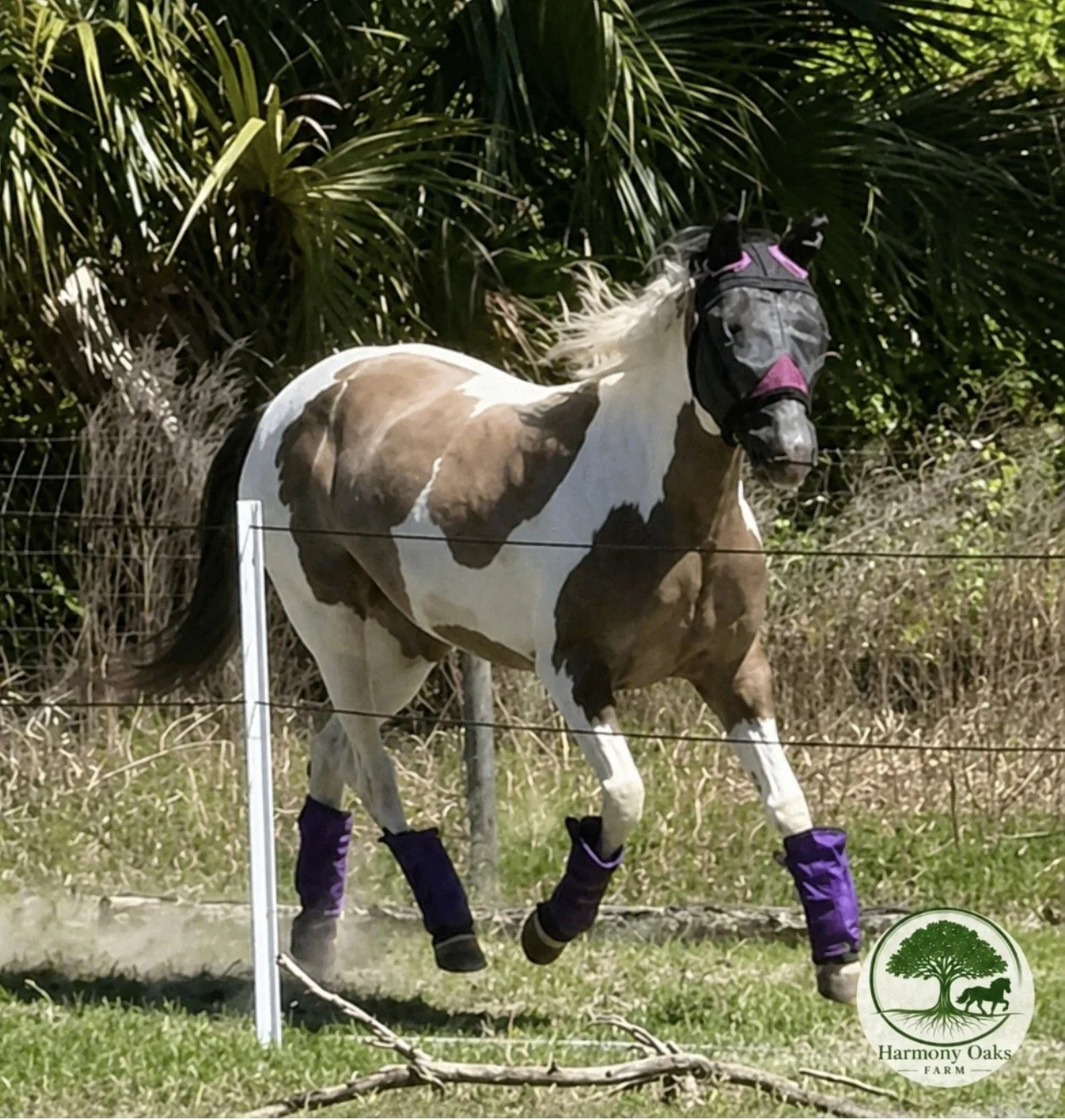
Spotted Mountain horse running on a track wearing a fly mask and fly boots
The Three Great Barriers: Skin, Gut, and Lung
Think of your horse’s body like a castle. To keep the "bad guys" (like allergens, bacteria, and toxins) out, the castle needs strong walls. In your horse, those walls are the skin, the gut lining, and the respiratory system.
According to the latest research, all three of these organs work using the same four-layer defense system:
1. The Physical Barrier: This is the actual "wall." In the skin, it’s tightly packed cells. In the lungs, it’s tiny hairs called cilia. In the gut, it’s the lining that keeps food moving along. The skin has an acidic pH (around 5.5) that kills off bad bacteria. The gut has acid and special antimicrobial peptides.
2. The Microbial Barrier: These are the trillions of tiny microbes (the microbiome) that live on the skin and in the gut. When these are healthy and diverse, there’s no room for the bad guys to move in.
3. The Immune Barrier: These are the local immune cells that live right in the tissue.
When one of these barriers breaks down, we call it "leaky." A leaky gut or a leaky skin barrier lets things inside that shouldn't be there, and that’s when the immune system goes into overdrive.
In the study of Icelandic horses a tolerance window was identified. It suggests that the age of the imported horse matters. This could translate to any other horses and their age at transition to a new environment and the stressors in that environment.
Iceland doesn't have the specific midges (*Culicoides*) that cause Summer Eczema, horses born there don't encounter the allergen until they are exported. The research shows there is a "Tolerance Window" early in life: usually in the first two years. If a horse encounters these bugs while they are young, their immune system learns that they aren't a threat. They build "tolerance."
Here is the data that really makes you stop and think:
Icelandic horses that encounter midges before age 2 have about a *20% risk** of developing IBH (the same as any other breed).However, horses imported as adults face a much higher climb. A horse imported at age 10 or older has up to a *96% risk** of developing Summer Eczema.
This tells us that the early years are vital for setting the immune system's "mindset."
If you are saying, that’s nice to know but my horse is older than that, what can I do for my horse?
The Skin Health Triangle: Lipids, Moisture, and pH
When we talk about the skin barrier, we have to look at the "Skin Health Triangle." To keep the barrier strong and "un-leaky," three things must stay in balance:
1. Lipids (Fats): These act like the mortar between the bricks of the skin cells.
2. Natural Moisturizing Factors (NMF): These keep the skin supple.
3. The pH Balance: Healthy horse skin should be slightly acidic (pH 5.5).
If your horse has dry, scaly skin or dandruff in their mane and tail, consider that a "warning light" on the dashboard. It means the triangle is out of balance. Dry skin is leaky skin. When the skin is dry, the pH rises, the "good" microbes leave, and "bad" guys like Staphylococcus aureus move in. These bad microbes can actually "reprogram" your horse's immune system to be more allergic.
The Atopic March: From Skin to Lungs
One of the scariest things discovered in recent studies is something called the "Atopic March." This is the idea that once a horse has one allergy, they are much more likely to get another.
For example, a horse with Summer Eczema has a significantly higher risk of developing Equine Asthma later in life. This happens because the immune cells that get "angry" in the skin can actually travel back to the bone marrow and tell the body to stay in an "allergic mindset."
This is why we can't just ignore a "little bit of itching." By protecting the skin barrier today, you are actually protecting your horse’s lungs and heart for the future.
Stewardship in Practice: How We Manage at Harmony Oaks
At Harmony Oaks Farm, we focus on stewardship that works with the horse’s natural biology. We don’t just want to treat symptoms; we want to support the barriers.
Using the Track System
We are big believers in the track system. Unlike a traditional small stall or a square paddock, a track system encourages constant, natural movement. This movement is essential for gut health. A moving horse has a moving gut, which helps maintain a healthy microbiome. The more diverse the environment the horse interacts with on the track, the more diverse their internal "good soldiers" become.
Diet and Supplements
For our horses showing signs of sensitivity, we pay close attention to minerals. The study highlighted that many imported horses are low in minerals. Minerals like copper and zinc are the building blocks of a healthy immune system and a strong skin barrier. Supplementing with bioavalialble minerals appropriate for the horse’s profile can make a world of difference.
We also watch the Omega-3 to Omega-6 ratio. Most modern horse diets are way too high in Omega-6 (which can be pro-inflammatory). Adding Omega-3s, like ground flax through quality sources helps keep those skin lipids healthy.
Practical Tips for Allergy Season
If you have a sensitive horse, here are some simple, science-backed steps you can take:
Be a Fan of Fans: Midges are terrible flyers. Putting high-powered fans in stalls or run-in sheds creates a "no-fly zone" that midges hate. Please be sure your fans are safe for the barn and are rated for outdoors and have a closed housing.
Consider fly sheets, fly masks, fly boots or bug blankets like Snuggy Hoods to protect the horses skin barrier, preventing bites
Wash the Blankets: If you use fly sheets, wash them regularly! Dust and skin cells trapped in the fabric can attract "house dust mites," which add another layer of irritation to an already itchy horse.
Targeted Skincare: If the skin is dry and scaly, don't just reach for a harsh medicated shampoo that might strip the natural oils. Look for ingredients like Urea, Glycerol, and Dexpanthenol. These help restore the moisture and the lipid barrier. We use products like Coat Defense or Hilton Herbs By Bye Itch
One of the biggest things that helped our herd was removing the inflammatory ingredients from the horses diet, transitioning to forage based diets, testing and supplementing with appropriate minerals to make the gut barrier strong
Use of fly traps (those cheesy plastic bags) and predator flies to cut down on environmental biting bugs that anger the horse’s systemic response
Natural fly sprays that aren’t hard on the horse’s skin but provide some shield for the horse
The Harmony Mindset
Caring for an allergic horse can feel like an uphill battle, but remember that you are your horse's best advocate. By moving away from "fixing the itch" and moving toward "supporting the barrier," you are giving your horse a much better quality of life.
Whether it’s through setting up a track system to encourage natural movement or being diligent about skincare before the scratching starts, every little bit of stewardship counts.
We are constantly learning more about how these incredible animals work. By focusing on the gut, the skin, and a low-stress lifestyle, we can help our horses find their own "harmony from within."
If you have questions about how we manage our horses or want to chat more about horse nutrition, feel free to reach out. We’re all in this journey together!